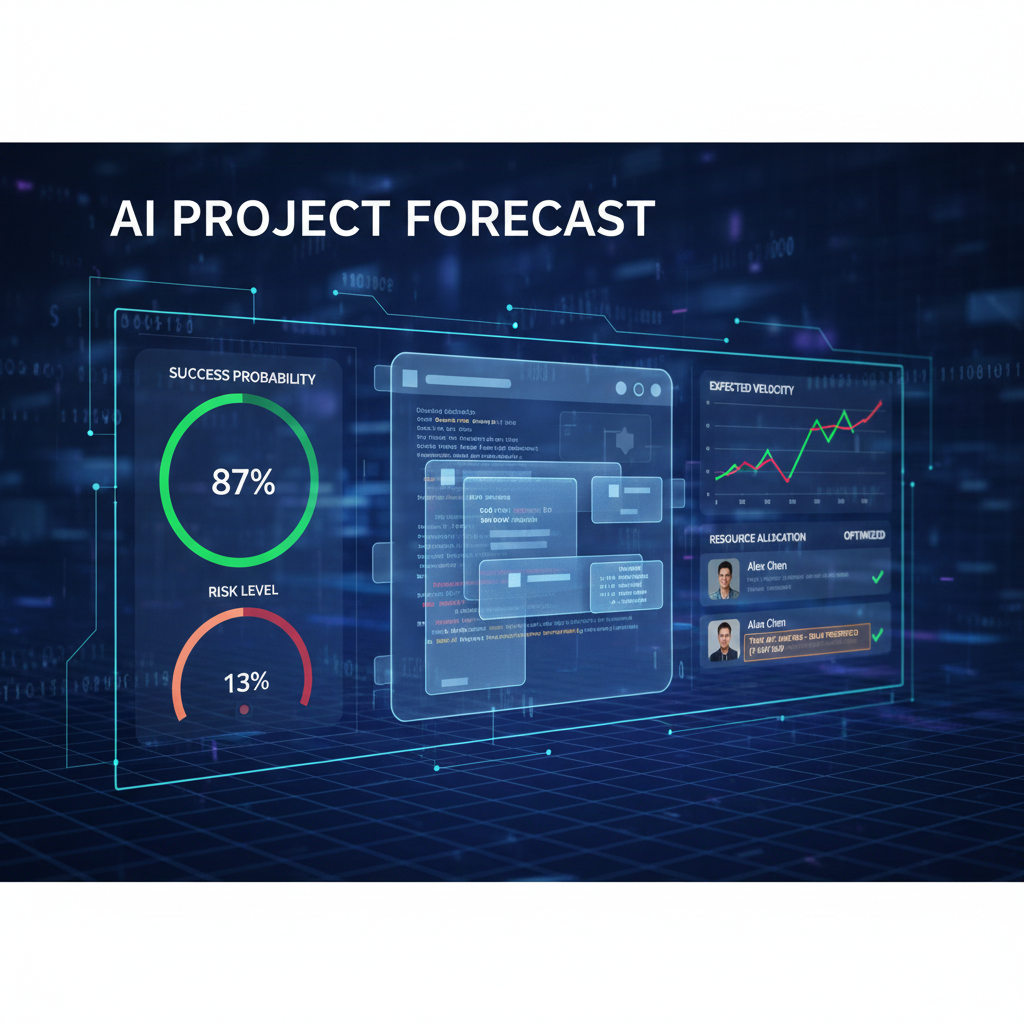
For decades, software project management has been an exercise in educated guessing. We analyze velocity, monitor burn-down charts, and hope for the best. Yet, despite our best efforts, projects still suffer from stealth delays, ballooning budgets, and missed requirements.
What if we could move from reactive reporting to proactive prediction?
The Paradigm Shift
Artificial Intelligence is transforming project management by analyzing historical data patterns that humans simply cannot see. Traditional tools tell you where you are; AI tells you where you are going.
Instead of asking, “What did we do last week?”, AI asks, “Based on the last 50 projects, what is the probability this task will delay our release by more than two weeks?”.
Key Application Areas
AI models are improving project forecasting accuracy in three distinct ways:
- Predictive Risk Assessment: AI analyzes commit frequency, code complexity, and developer activity to flag high-risk tasks before they become blockers.
- Resource Allocation Simulation: Leaders can run “what-if” scenarios to predict the impact of changing team composition or shifting deadlines.
- Effort Estimation: AI refines estimations by learning from past projects’ actual hours versus planned hours, reducing human bias.
The Limitations: Where AI Falls Short
While powerful, AI is not a panacea. Leaders must understand these critical limitations:
- Dependency on Quality Data: If your Jira tickets are poorly maintained or time logs are inaccurate, the AI’s predictions will be flawed.
- Context Blindness: AI cannot understand the nuances of a demotivated team or complex stakeholder politics—it only understands data points.
- The “Black Box” Problem: It is crucial to use AI tools that explain why they flagged a risk, rather than just giving a probability score.
Bridging the Gap: How to Implement
To start using AI for project outcome prediction, consider the following implementation roadmap:
- Audit Your Data: Ensure your project management tools are capturing actionable data (e.g., ticket transitions, pull request cycle times) rather than just project status.
- Train on Historical Data: Feed the model past project data—especially those that were delayed—to help it recognize early warning signs.
- Human-in-the-Loop: Use AI predictions as a conversation starter for project managers, not as a replacement for their judgment.
Conclusion
The future of software project management isn’t about replacing project managers; it is about empowering them with foresight. By leveraging AI to predict outcomes, we can focus less on fire-fighting and more on delivering value.
